Mowat’s first encounter with Mike and his husky team
Never Cry WolfMowat’s first encounter with Mike and his husky team begins as a comic misidentification and becomes the practical and human starting point of his life in the Barrens. Expecting wolves when he hears a pack howling toward his camp, Mowat takes shelter beneath his overturned canoe. The animals surrounding it turn out to be fourteen Huskies, led by Mike, a young trapper who will provide a cabin, transport, and access to local knowledge. The reversal shifts the story from imagined contact with its study species to the relationships that make sustained observation possible.
The Expected Wolves
By the time Mowat finished his business with Peru, darkness was gathering and he had seen no wolves. A distant movement and then the sound of a pack howling in his direction seemed to solve the immediate problem of finding his study animals. But the apparent solution brought fresh anxiety: he had only six rounds for his pistol, could not remember where he had put the reserve ammunition, and could not tell how many animals were approaching. Unable to see well enough to assess them, he crawled beneath his upturned canoe, partly to keep his presence from affecting their behavior and partly because he feared damage to the lightly built craft would leave him stranded.
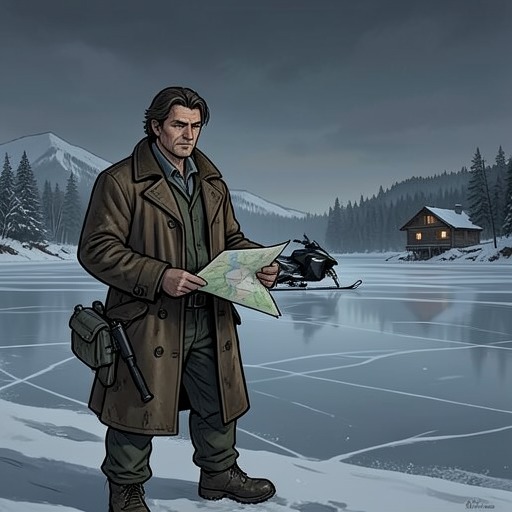
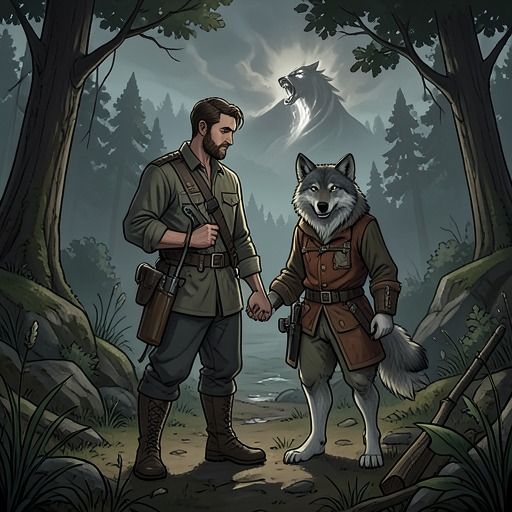
From beneath the canoe he heard the pack sweep around his equipment and rush at the shelter. The uproar ended in a sudden silence. When Mowat cautiously looked through a gap, he first saw numerous wolf feet, then a pair of feet that could not belong to a wolf. He raised the canoe and found a young man in caribou furs, surrounded by fourteen large Huskies. There were no wolves. The gap between the approaching sound and the scene revealed at close range gives the encounter its defining turn: Mowat’s first apparent contact with the animals he came to study is actually his first contact with a person who can help him live and work in their country.
Mike and the Field Base
The dog owner was Mike, an eighteen-year-old trapper of mixed Inuit and white parentage who lived in a cabin a few miles away. Apart from a small group of Inuit, including his mother’s family, about seventy miles to the north, Mike was the only human inhabitant in an area Mowat estimated at roughly ten thousand square miles. For the proposed wolf study, that isolation seemed valuable: Mowat believed that little human traffic would disturb his observations. At the same time, the encounter immediately showed that isolation did not mean he could work independently of local people.
Mike initially regarded the unexplained arrival with suspicion. He had never known an aircraft to land in his part of the Barrens and had seen only a few planes passing high overhead. Unable to reconcile the stranger and his large quantity of equipment with anything familiar, he entertained a supernatural explanation and kept his 30–30 rifle with him during the first days. Mowat’s introduction of wolf-juice helped ease the distance between them, though the narrative presents the change wryly rather than as proof that the men understood one another.
That first night Mike led Mowat to his cabin, a modest structure of poles roofed with decaying caribou hides. Mowat recognized it as a workable base. He was authorized by the Department of Mines and Resources to hire local help only within a very small monthly allowance, yet made a deal offering Mike an official ten-dollar IOU for three months’ lodging and assistance as guide and general helper. He judged the payment generous by the prevailing rates paid to Arctic residents, and justified the expense by the value of the equipment that might otherwise be lost when the lake ice melted. He later suspected the bargain was one-sided and that Mike may not have fully understood its implications. Whatever its fairness, Mike supplied his dog team to move the equipment to the cabin, making the encounter materially consequential as well as personal.
From First Contact to Shared Work
Mowat spent the following days unpacking equipment and setting up a field laboratory in the small cabin, taking up much of its limited space. He noticed that Mike seemed preoccupied but, on such a short acquaintance, did not press him to explain. Scientific demonstrations fascinated Mike without easing his distress. After Mowat showed him cyanide wolf getters and explained their effects and concealability, Mike began carrying a long stick and probing chairs, food, boots, and clothing before using them. The episode exposes a limit in Mowat’s early approach: demonstrating scientific apparatus did not necessarily make its meaning clear, and what seemed to him a useful explanation could have a different effect on his companion.
A later relationship with Ootek offered a striking contrast. Mowat says he never managed to make Mike understand the importance and nature of his research, whereas Ootek appeared to share his sense that the work mattered, whether or not he understood its scientific framework. Ootek eventually attached himself to Mowat’s observation camp. He was interested in wolves in part because his personal helping spirit was Amarok, the Wolf Being, and he regarded wolves as relations rather than as the feared creatures of common social belief. He also told Mowat of having been taken to a wolf den as a small child, where he played among the pups and was left unharmed by the adults. Mowat treated such accounts as claims requiring corroboration; he found that when independent proof could be obtained, Ootek’s information was consistently right.
A Wider Human and Ecological Context
The encounter’s significance extends beyond the establishment of a camp because Mike and Ootek connect Mowat’s investigation to distinct forms of knowledge and to the human use of caribou. Ootek described wolf and caribou as so closely linked that they were almost a single entity, and related an origin story in which the caribou was given as sustenance for people. This account gave cultural and ecological meaning to a relationship Mowat was also trying to understand through observation. It did not make the two kinds of explanation interchangeable: the narrative distinguishes Ootek’s story from Mowat’s scientific verification, while showing how local testimony directed attention to questions his initial expectations had not answered.
Mike’s practical knowledge also challenged the official explanations Mowat had read about the decline of the Keewatin caribou herd. Government inquiries had gathered responses from trappers and traders, who generally reported killing only one or two caribou a year and blamed wolves for killing vast numbers. Mike explained that trappers needed to kill caribou to feed themselves and their dogs through the winter; fish could substitute when necessary, but did not keep working dogs strong. Mowat knew there were 1,800 trappers across parts of Saskatchewan, Manitoba, and southern Keewatin within the herd’s winter range. Even after halving both the number of trappers he counted and Mike’s annual kill, his rough calculation reached 112,000 caribou killed by trappers each year—an estimate he believed he could not safely put in his reports. The first meeting thus opens into a conflict between official accounts and knowledge gained through direct conversation, without turning Mike’s testimony into a complete explanation by itself.
Later, Ootek reported that wolves were relaying news of the southward-moving caribou from territory to territory, with George passing on information that had itself come through another wolf. Mowat remained skeptical, but Mike set out to hunt on the report. Elsewhere on their travels, Ootek introduced Mowat to a family camped near a river crossing where men hoped to intercept caribou for winter provisions; Ootek wished to join their hunt, and Mowat agreed to wait. These episodes make the initial meeting with Mike more than a convenient introduction: it places Mowat among people whose movements, livelihoods, and accounts of animal behavior shape the fieldwork that follows. The encounter begins with a pack that is not a wolf pack, but it leads toward a study in which neither animal observation nor scientific equipment alone can explain the country.